
4.3 KiB
Real2Sim Studio
A local-first workbench for 3D assets and Genesis simulation exports.
中文 · Offline example · Roadmap · Contributing · MIT license
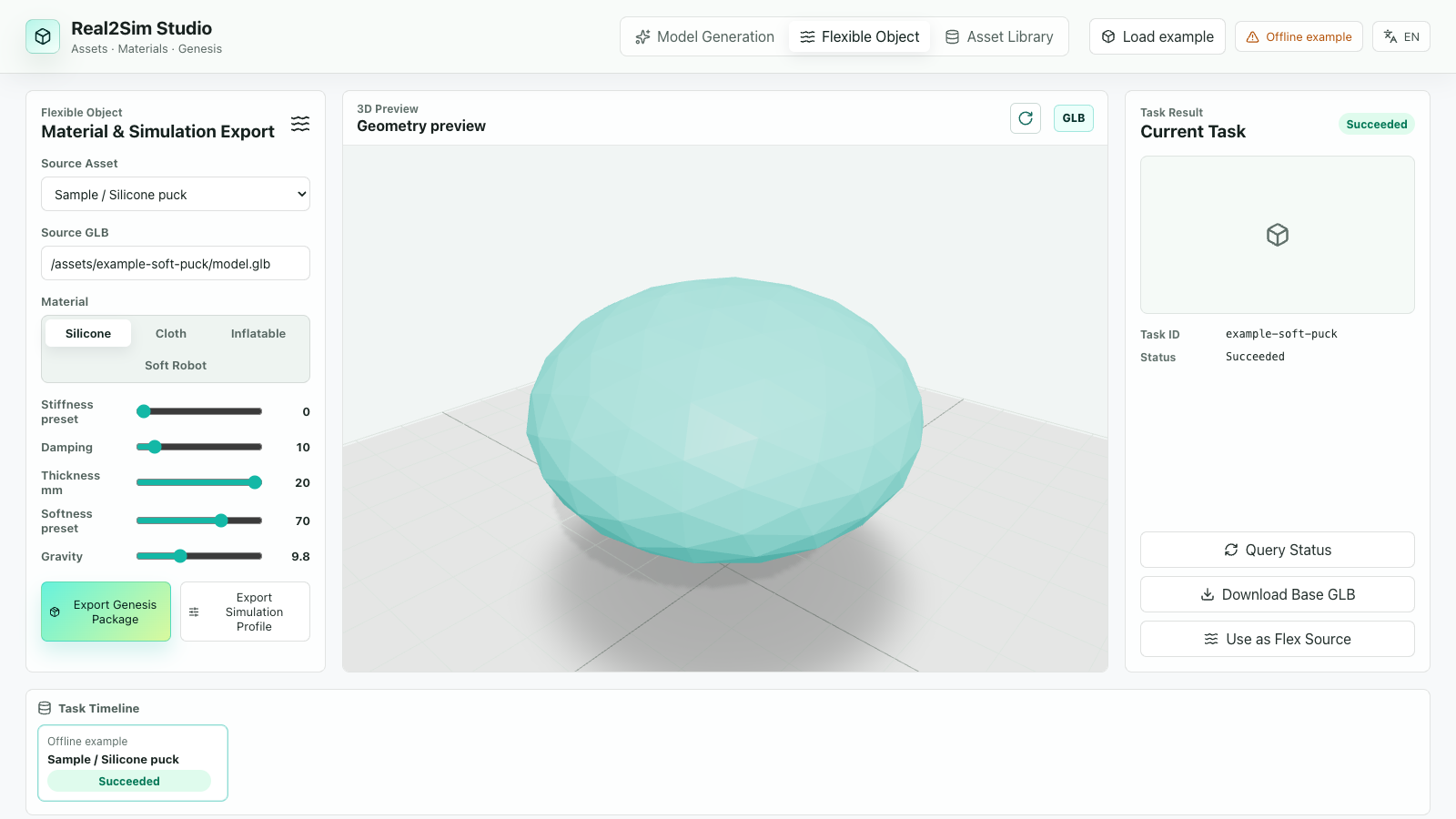
Inspect a GLB, configure a material preset and export a self-contained Genesis scene. Start with the included procedural example without an API key, or connect your own DashScope account for Tripo text/image-to-3D generation.
Try it
Requires Node.js 22.12 or later.
git clone https://github.com/eust-w/real2sim-platform.git
cd real2sim-platform
npm ci
npm run demo
Open the Vite URL printed in the terminal (normally http://127.0.0.1:5173). Select Load example, rotate the model, adjust the material controls, then Export Genesis Package. Demo mode cannot make paid generation calls and uses .data/demo/, separate from your usual tasks.
What is included
- Text, single-image and multi-image generation through DashScope / Tripo using your own account.
- Local task history and asset caching, GLB preview and downloads.
- A self-contained, MIT-licensed procedural sample.
- Material preset controls and Genesis export using the current settings, including gravity.
- FEM elastic export and an experimental PBD cloth export path.
- English / Chinese UI, unit tests, backend type checking and browser smoke tests.
The package contains the mesh, flex-profile.json, manifest.json, genesis_scene.py, pinned runtime requirements and instructions. Physics runs in Genesis, not in the browser preview.
Run the exported scene
See the complete example guide for Python environment setup.
npm run example:export
python3.11 -m venv .venv
source .venv/bin/activate
pip install -r examples/requirements.txt
python .data/genesis-packages/example-soft-puck/genesis_scene.py --steps 800 --record
The first run compiles solver kernels. Without --record, the scene runs numerical checks and saves metrics and a trajectory without requesting a camera. The recorded result uses the actual Genesis solver, not an animated preview.
Alpha security limitation: the optional Python runtime has known Pillow advisories constrained by an upstream MoviePy dependency. Use only the trusted example in an isolated environment; see the audit note. The Node audit and Python audit are separate.
Optional AI generation
cp .env.example .env.local
# Set your DashScope API key in .env.local.
npm run dev
Generation uses an external paid service. Provider models, generated assets and service terms are not covered by this repository's MIT license. A flexible variant is a new prompt-based generation; it is not deformation or reconstruction of the original GLB.
The local API defaults to 127.0.0.1:8789. Set PORT before starting to change it; the development proxy uses the same value. This is a single-user local application, not a publicly hosted service. See Security.
Limits
- Material values are illustrative presets, not calibrated estimates from real objects.
- The included mesh is procedural. Arbitrary generated meshes can fail tetrahedralization and may need repair or unit correction.
- Cloth requires an appropriate surface mesh. Inflatable/soft-robot presets do not simulate pressure or actuators.
- No robot training, scene reconstruction, measured sim-to-real accuracy or universal model compatibility is claimed.
- The current exporter targets Genesis World 1.4.5. Newer releases may change APIs.
Development
npm run test:run
npm run lint
npm run build
npx playwright install chromium
npm run test:e2e
npm audit
The browser test uses isolated data, exports a real GLB package, verifies current slider values, checks canvas pixels and rotation, and captures desktop/mobile screenshots. Physics execution is a separate Python check, not implied by passing the TypeScript tests.
License and credits
MIT for this workbench and its procedural sample. See third-party notices. Built with React, Three.js, Express and Genesis World; optional generation is provided by Tripo through DashScope. This project is independent of those upstream projects and providers.